Kernel Warping
High Point Density left a wide strain distribution unexplained. Its 11024 Gauss points ranged from about -16400 to 106100 microstrain. VIC-2D's own measurements of the same stretch stayed between about 17300 and 23100. That page blamed element size: a fixed tracking error, divided by a small element size , becomes a large strain error.
That explanation leaves out the tracking error's shape. This page measures the error against each point's known true position. The error follows a wave, with an amplitude of about 0.13 px, tied to where each point's true position falls within its pixel. That wave explains High Point Density's vertical stripes.
This page introduces locate_warp, a subpixel method different from
locate_subpixel. It cuts the error's standard deviation from
0.109 px to 0.008 px. Relative
to the locate_subpixel baseline, locate_warp shrinks the strain
spread by a factor of 14, from a standard deviation of 16531 to 1161
microstrain.
Pixel Locking
This page's 2% stretch sends every reference point to a new known location,
( remains constant for all points). The
High Point Density page's own locate_subpixel
call already tracked all 2862 of those points. Subtracting each point's known true
position from its tracked one gives the tracking error:
- x error: mean -0.0110 px, std 0.1091 px
- y error: mean +0.0005 px, std 0.0385 px
Each row's x error vs. the all-row mean: correlation 0.82 to 0.94; row 27 (y = 151 px): 0.82
Saved: kernel_warping_pixel_locking.png
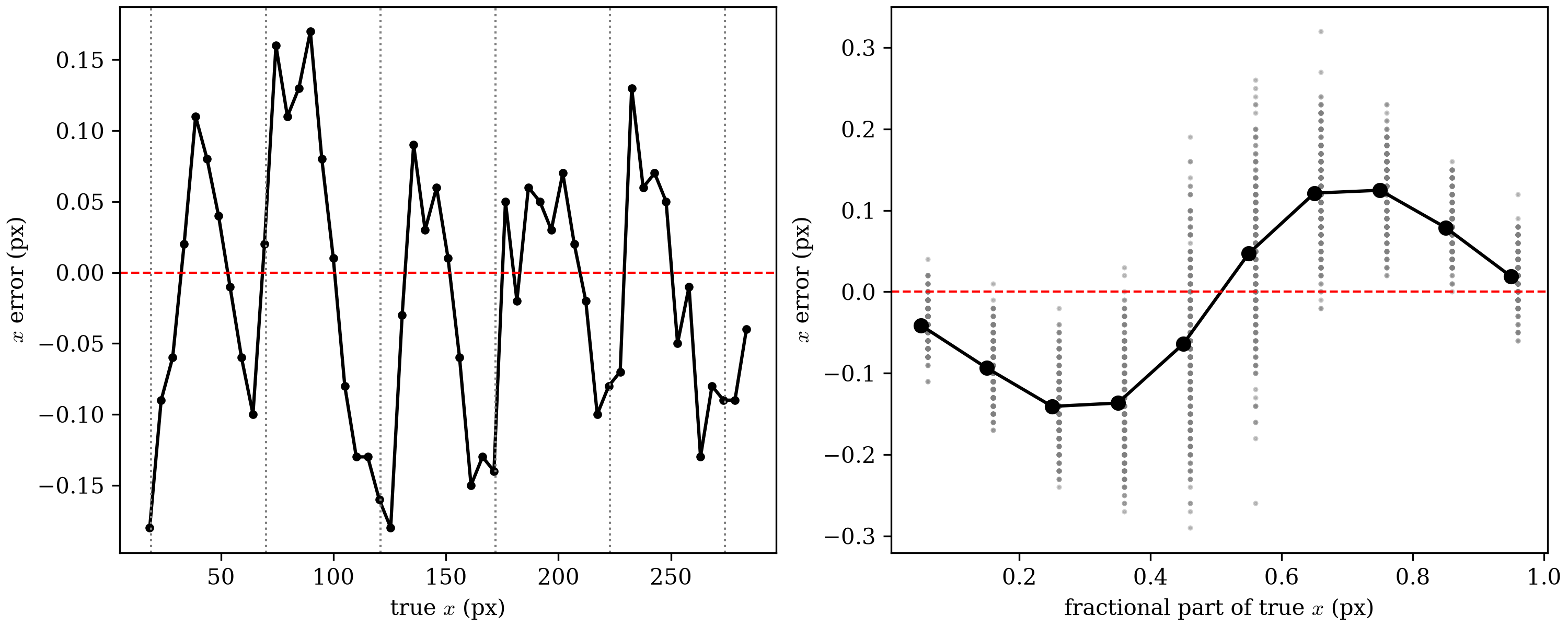
The right panel shows the error depends on where the true position sits
within its pixel. Points with a fractional part between 0 and 0.5 read
low, by as much as 0.14 px near 0.3. Points between 0.5 and 1 read high,
by as much as 0.12 px near 0.7. Points at an exact half pixel read about
right. This is pixel locking: a subpixel estimator's
answer drifts toward whole-pixel values. locate_subpixel refines the
peak of an upsampled phase correlation surface. That surface comes from
a zero-padded kernel, and its peak shifts in a way that depends on the
true fractional position. About half of this wave's size comes
from how the stretched image itself was made: image.stretch uses
bilinear interpolation. The Residual
Wave separates the two causes.
The left panel shows why this matters for strain. Every reference position on the grid is a whole pixel. So the true position, , has the same fractional part as . That fractional part climbs from 0 to 1, then wraps back to 0, each time grows by 1. That takes reference pixels. The stretch scales those 50 px by 1.02, so one cycle spans pixels in the current image. So the bias itself forms a wave along , with an amplitude of about 0.13 px and a period of 51 px. Strain measures the slope of displacement. The slope of that wave swings to about , or 16000 microstrain. That is the same order as High Point Density's measured standard deviation, 16531 microstrain. The same wave explains the vertical stripes in that page's field figure, one stripe pair per cycle.
It also explains why Simple Stretch Revisited never saw this. That page spaced its points 50 px apart, one full bias cycle. Every true position landed on a whole pixel, so every node sat at the same point on the wave. High Point Density's 5 px spacing spread the nodes across the whole wave, and the error showed up in every element.
Inverse Compositional Gauss-Newton
Commercial DIC codes such as VIC-2D warp the kernel itself, instead of
refining a correlation peak (as done by locate_subpixel).
dictk.grid.locate_warp warps
the kernel too, as VIC-2D does. It works in two stages:
- First,
dictk.translation.locatefinds the nearest whole pixel. - Second, inverse compositional Gauss-Newton (IC-GN) refines it.
IC-GN lets the reference kernel deform by an affine warp, , with six parameters: , , , , , and . and are the displacements along and . The subscripts mark their gradients across the kernel, so and :
Here labels each pixel of the reference kernel by its fixed offset from the kernel's center, from to px here. The warp maps each such pixel to its position in the current image. IC-GN searches for the that minimizes the zero-normalized sum of squared differences (ZNSSD) between the reference kernel and the current image sampled through the warp, :
Here and are the mean intensities over the 729 pixels of and (the kernel spans 13 px on each side of its center pixel, so ). The double bars denote the Euclidean norm of those pixel values.
Each iteration solves for a small update to the reference kernel. It then composes that update's inverse into the current warp, . The inverse compositional form puts all gradient work on . It computes the Hessian once per point, not once per iteration. Cubic B-splines sample at the warped, fractional positions. The tracked position is the warp's own translation, .
Deriving the Update
Four steps lead from to the update IC-GN applies.
dictk.warp's refinement follows them in
order. Below, names one
pixel's offset in the kernel, and every sum runs over all
pixels.
1. Reduce ZNSSD to least squares. Write and for the zero-mean kernels. Then write and for the same kernels scaled to unit length, so and . The bracket in is . Its square expands to . Summing over the pixels gives
So minimizing maximizes ZNCC, the criterion from Correlation Criteria. ZNCC runs from to , because is the dot product of two unit-length vectors. So runs from 0 to 4. is a perfect match, where . is a perfectly inverted pattern, where .
Next, let , the sum of the squared zero-mean reference intensities. It depends only on the reference kernel, not on , so it is a constant. Multiplying by it leaves the minimizer unchanged:
2. Put the increment on the reference kernel. A forward, additive Gauss-Newton step would perturb the current side, . Its linearization needs the gradient of at the warped positions. Those positions move every iteration, so the 6x6 Hessian would need rebuilding every iteration too. The inverse compositional form perturbs instead. It seeks the incremental warp that makes the reference kernel match the current one:
If matches , then matches . That gives the update, . In the matrix form above, composition is matrix multiplication. At convergence, , and the two forms share the same minimum.
3. Linearize about . is the identity, so a first-order Taylor expansion gives
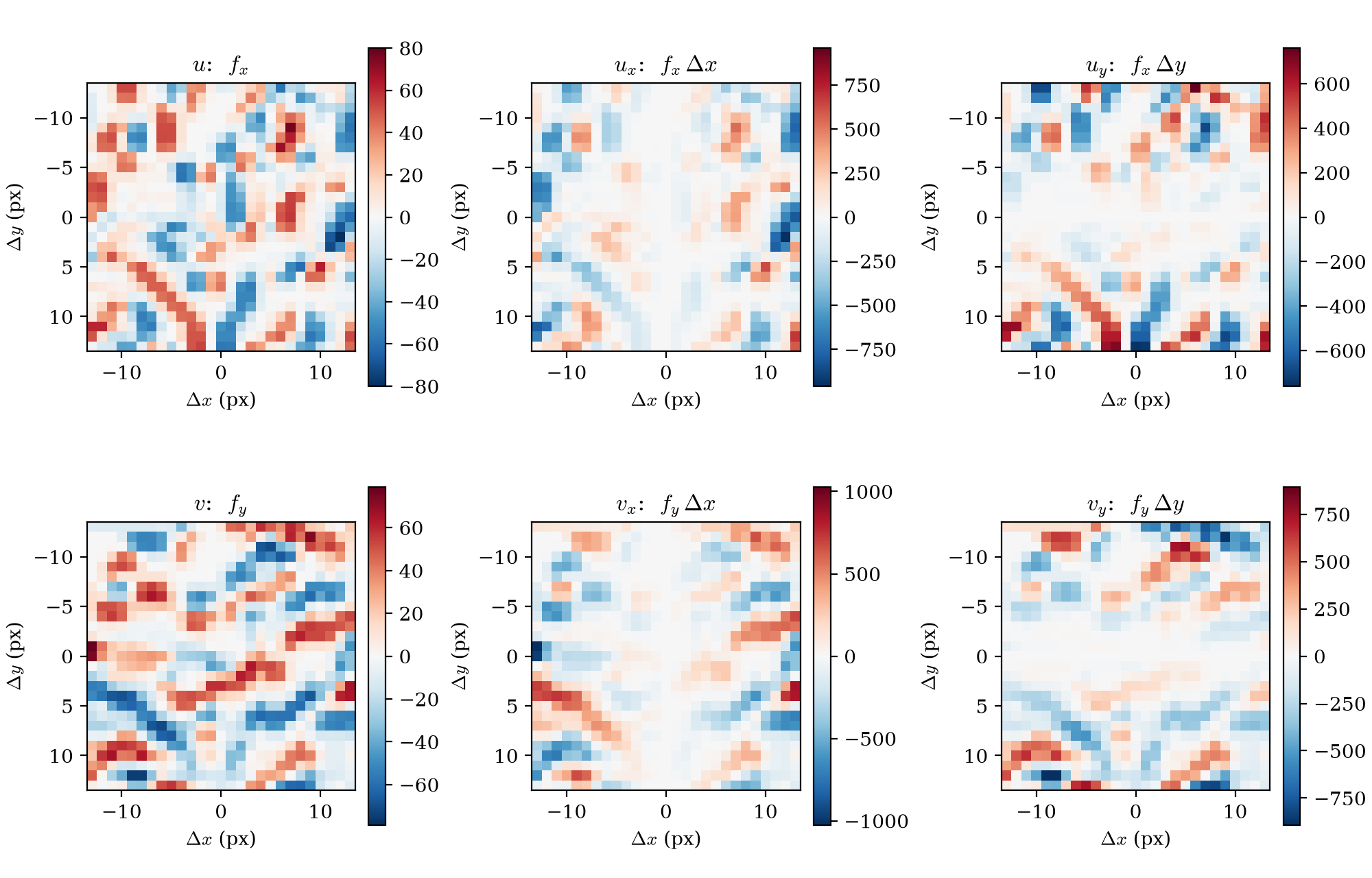
with , the reference image's gradient. The product is one row of six numbers per pixel, its steepest-descent row:
The expansion holds and fixed. That approximation vanishes as .
Figure 9.3-2 shows the six components of as images, for the reference kernel at . Rigid Versus Warped Kernel below tracks that same kernel. The and images are the image gradient itself. The other four multiply that gradient by or . So they vanish along the kernel's center column or center row. A pixel 13 px from the center weighs 13 times more than a pixel 1 px from it. The kernel's edges carry the information about stretch and shear.
4. Solve the normal equations. Define the residual . Substituting step 3 into step 2 leaves a linear least-squares problem,
Setting its gradient with respect to to zero gives
is . It depends only on and , never on . So IC-GN builds and inverts it once per point, before the first iteration. That is the payoff of step 2.
Iterating. The first comes from locate's
whole-pixel answer: and take its displacement, and all four
gradient terms start at zero. Each iteration then does five things:
- Sample at the 729 warped positions with cubic B-splines.
- Form , , and the residual .
- Solve for .
- Build , invert that matrix, and compose it into .
- Stop once every component of falls below , or after 50 iterations.
One example shows those iterations in action: the point at
, under a 7% stretch, a 0.05 shear, and a px
shift. Rigid Versus Warped Kernel below
explains how that example was chosen.
dictk.warp.fit with max_iterations
set to returns the warp after iterations. Iteration 0 is
locate's whole-pixel start. Figure 9.3-3 shows the
residual after each iteration, and Figure 9.3-4
the error:
IC-GN reaches its final warp after 9 iterations:
| Iteration | ZNSSD | Translation error (px) | Gradient error |
|---|---|---|---|
| 0 | 1.77e-01 | 4.37e-01 | 7.00e-02 |
| 1 | 2.20e-03 | 1.76e-02 | 4.08e-03 |
| 2 | 1.21e-03 | 2.69e-03 | 8.24e-04 |
| 3 | 1.19e-03 | 3.19e-03 | 2.88e-04 |
| 4 | 1.19e-03 | 2.79e-03 | 1.37e-04 |
| 5 | 1.19e-03 | 2.87e-03 | 1.24e-04 |
| 6 | 1.19e-03 | 2.85e-03 | 1.17e-04 |
| 7 | 1.19e-03 | 2.86e-03 | 1.16e-04 |
| 8 | 1.19e-03 | 2.85e-03 | 1.16e-04 |
| 9 | 1.19e-03 | 2.86e-03 | 1.16e-04 |
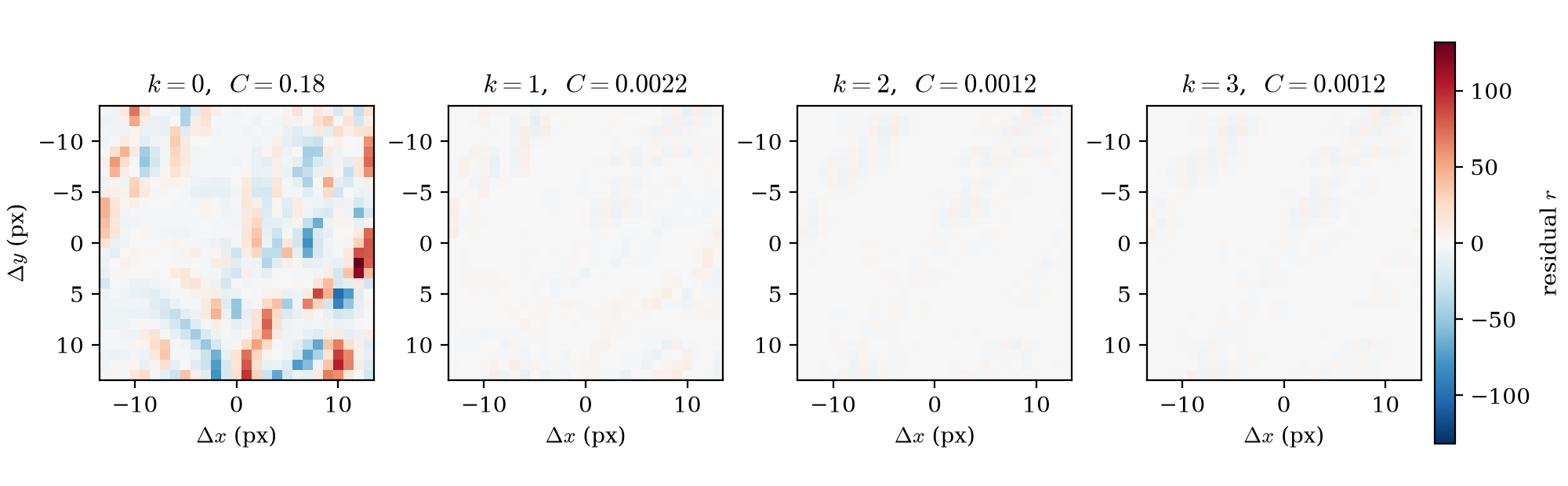
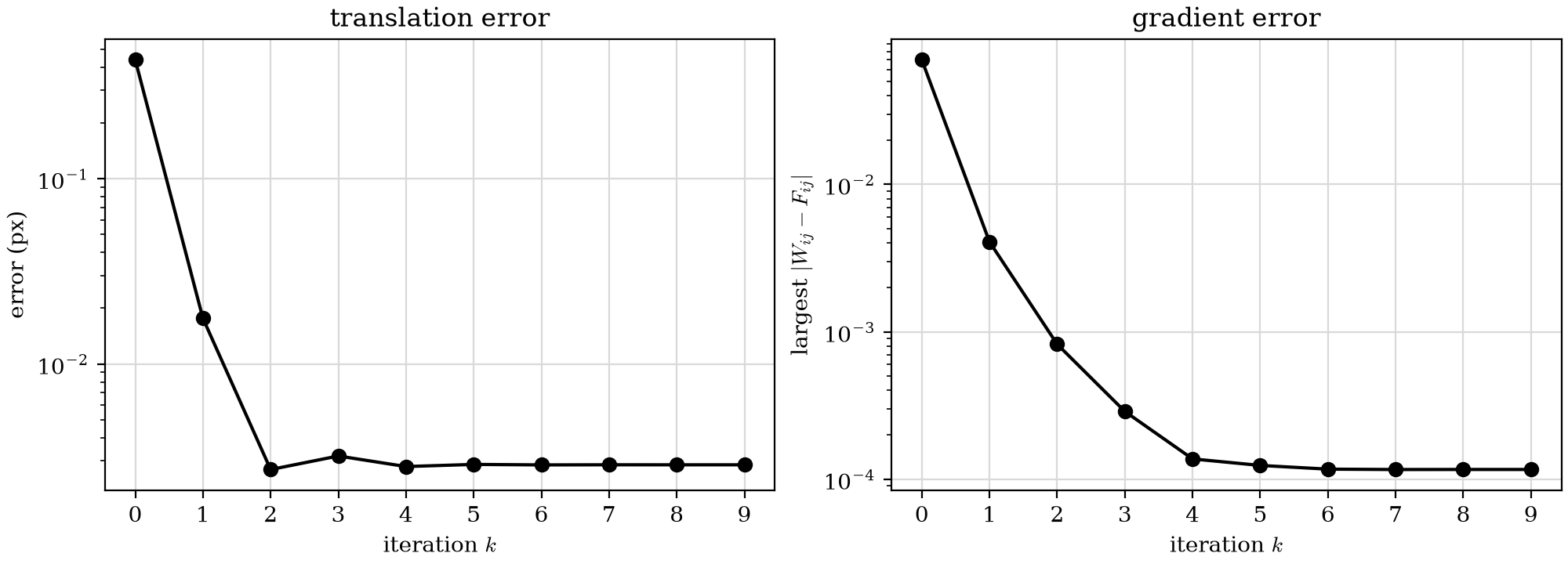
One iteration cuts from 0.18 to 0.0022, and the translation error from 0.44 px to 0.018 px. By , levels off at 0.0012, and the translation error settles at about 0.003 px. The gradient terms take until to settle, at about . IC-GN stops after 9 iterations, the first one where every parameter's update falls below the default tolerance of . The error stops improving at , but the updates take three more iterations to shrink below that tolerance. The 50-iteration cap never applies.
Neither error reaches zero. This example's current image comes from a
quintic spline, while IC-GN samples it with a cubic one. That mismatch
sets the 0.003 px floor. Rigid Versus Warped
Kernel below finds the same 0.003 px as
locate_warp's median error across 30 shifts.
Rigid Versus Warped Kernel
locate and locate_subpixel never warp their kernel. Each cuts an
axis-aligned square from reference_image. Each slides that square,
unchanged, across the search area. The only thing either one finds is
a translation. In contrast, locate_warp finds how the kernel
translates and deforms.
One point, at , under an exaggerated deformation shows the difference. The current image stretches 7% along and shears by 0.05. The 7% stretch is 3.5 times this page's 2%, large enough to see the warp.
A shift then moves the point by a fractional number of pixels. A
whole-pixel shift would hand locate an exact answer by construction,
since locate only returns whole pixels. So the first table tracks
the point under 30 random fractional shifts, each between 4 and 8 px
along and between 2 and 6 px along . Figure 9.3-5 uses the one
shift whose three errors sit closest to the three median errors in
that table. The second table tracks that shift. Then come the warp
matrices, , from locate_subpixel and locate_warp,
followed by the true one:
Across 30 random fractional shifts:
| Function | Smallest error (px) | Median error (px) | Largest error (px) |
|---|---|---|---|
locate | 0.081 | 0.462 | 0.658 |
locate_subpixel | 0.054 | 0.105 | 0.150 |
locate_warp | 0.001 | 0.003 | 0.006 |
The most typical shift, (6.43, 4.92) px, puts the true position at (156.43, 154.92):
| Function | Found | Found | Error (px) |
|---|---|---|---|
locate | 156.000 | 155.000 | 0.437 |
locate_subpixel | 156.340 | 154.970 | 0.103 |
locate_warp | 156.432 | 154.918 | 0.003 |
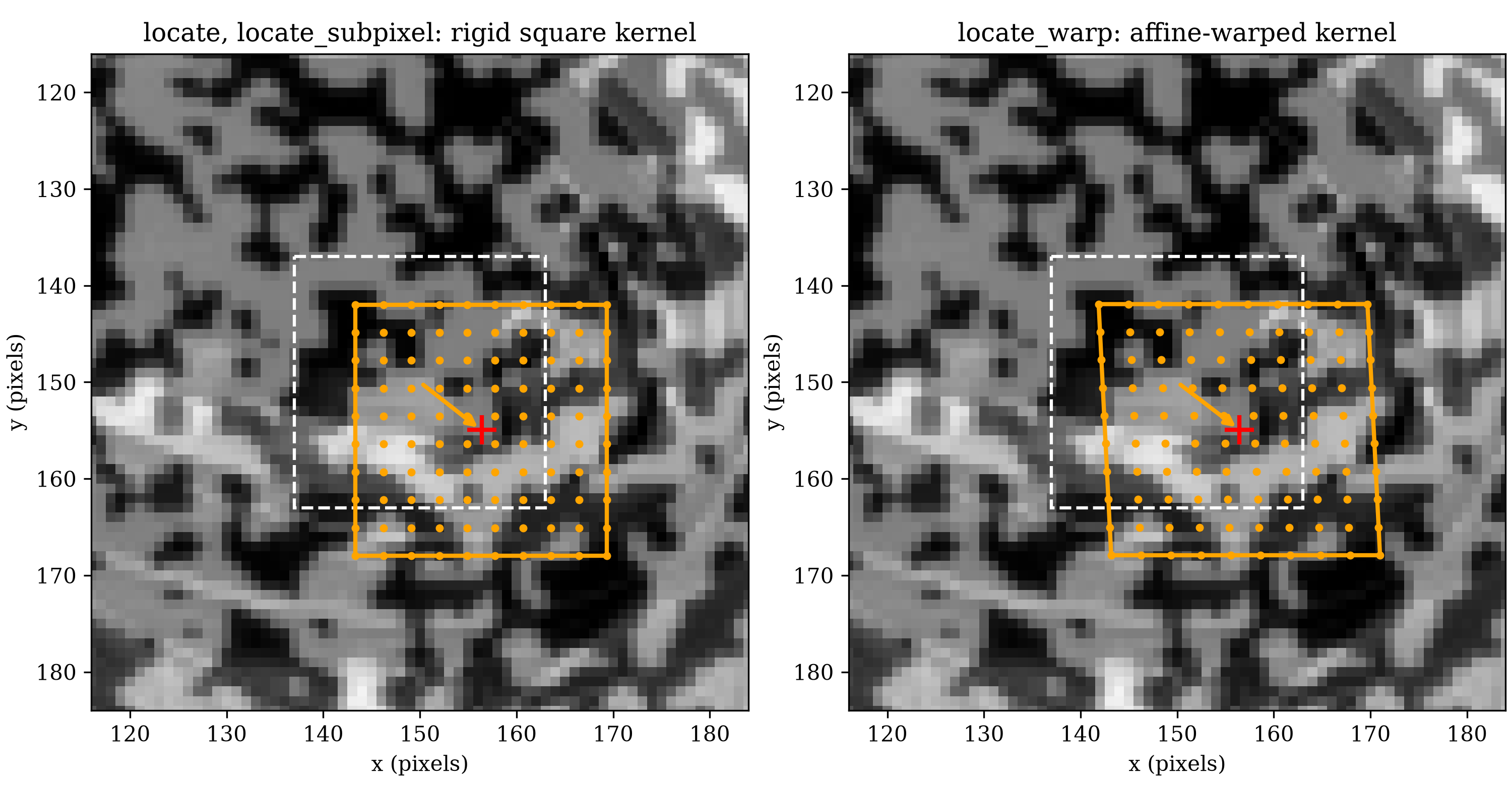
locate and locate_subpixel move the square without changing its shape (drawn at locate_subpixel's position). Right: locate_warp also stretches and shears the kernel. Its outline and sample points use the warp IC-GN fitted, .Across all 30 shifts, locate misses by a median 0.462 px, since it
rounds to a whole pixel. locate_subpixel misses by a median 0.105
px, because its rigid square no longer matches the stretched and
sheared content. locate_warp misses by a median 0.003 px, about 35
times smaller than locate_subpixel's. Even locate_warp's largest
miss over all 30 shifts, 0.006 px, is about 9 times smaller than
locate_subpixel's smallest, 0.054 px.
keeps an identity block in
its upper left. A rigid kernel can only translate, so its four
gradient terms stay at zero. is
the warp IC-GN fitted.
dictk.warp.fit returns it directly.
Its gradient block matches to about
0.0001. Its translation matches to within 0.003 px.
Two things reduce the bias. The spline samples the image itself at
fractional positions, so no correlation peak needs interpolating. The
affine warp also lets the kernel stretch along with the material,
instead of forcing a rigid match. The call mirrors locate_subpixel,
with the same grid and margins:
Show the locate_warp call
from dictk.grid import locate_warp

found = locate_warp(
    reference_image=reference_image,
    current_image=current_image,
    reference_points=points,
    kernel_margin_width=13,
    kernel_margin_height=13,
    search_margin_width=25,
    search_margin_height=25,
)
The same fractional-position error curve, now for both trackers:
| Tracker | Time (s) | Mean error (px) | Std error (px) | Max | error| (px) |
|---|---|---|---|---|
locate_subpixel | 1.6 | -0.0110 | 0.1091 | 0.3200 |
locate_warp | 1.7 | -0.0000 | 0.0080 | 0.0234 |
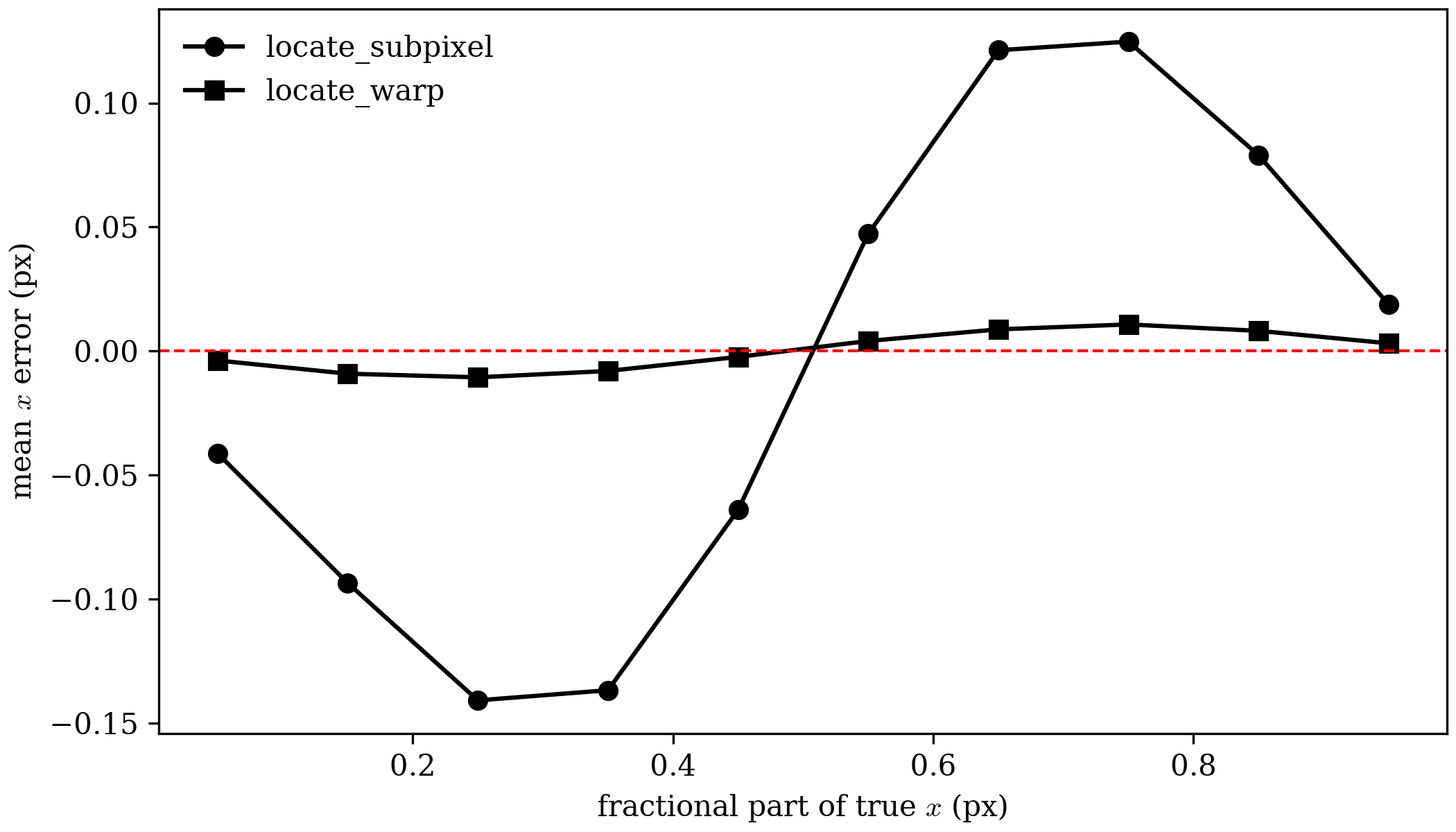
locate_subpixel (circles) and locate_warp (squares), across all 2862 points.The error standard deviation falls from 0.109 px to 0.008 px. The table lists both run times. For all 2862 points they differ by less than a second. A residual wave, about 0.01 px tall, remains. The Residual Wave traces it to the test image.
Figure 9.3-7 shows the 2862 locate_warp errors
behind that 0.008 px. They come from the same points as
Figure 9.2-1's
locate_subpixel errors:
2862 points: mean x error -0.00004 px, std 0.0080 px, range [-0.023, +0.021] px
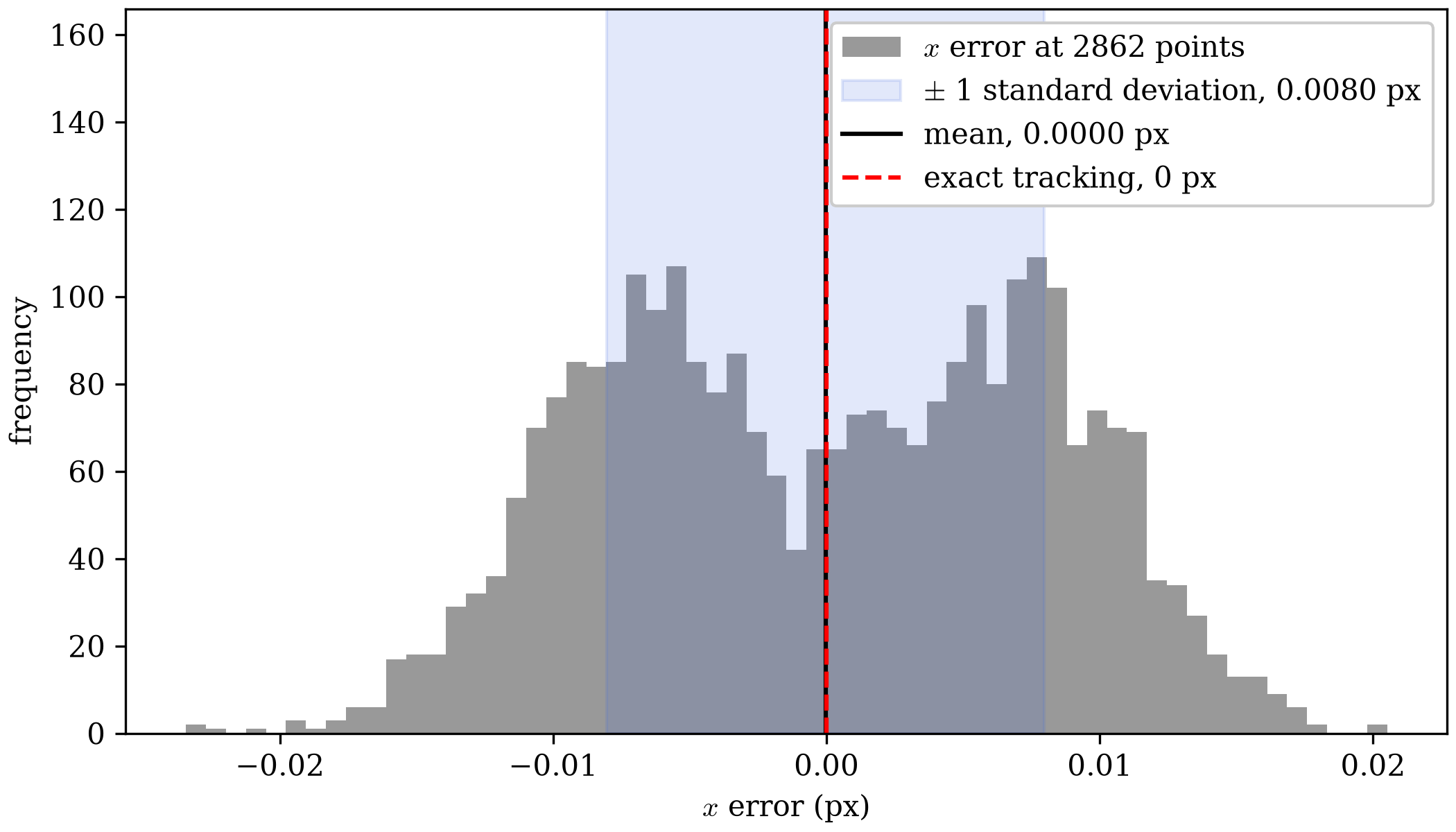
dictk.grid.locate_warp's error across all 2862 points (gray, 60 bins). The dashed red line marks exact tracking, 0 px. The solid black line marks the mean of the 2862 errors, 0.0000 px. The blue band spans one standard deviation, 0.0080 px, on each side of that mean. Range is [-0.023, +0.021] px.The mean error is 0.0000 px to four decimals. The standard deviation is
0.0080 px, 13.6 times smaller than locate_subpixel's 0.1090 px. The
errors span [-0.023, +0.021] px, against locate_subpixel's
[-0.29, +0.32] px.
Strain locate_warp
High Point Density's strain pipeline stays the same:
dictk.grid.elements for
connectivity, then
gauss_point_log_strains
at each Gauss point. Only the tracked positions change:
| Source | Mean (µε) | Std (µε) | Min (µε) | Max (µε) | Inside [17560, 22360] |
|---|---|---|---|---|---|
locate_subpixel + Q4 | 20465 | 16531 | -16446 | 106134 | 9.5% |
| VIC-2D | 19876 | 1385 | 17330 | 23137 | 98.2% |
locate_warp + Q4 | 19851 | 1161 | 16562 | 23160 | 97.4% |
| Analytical, | 19803 | 0 |
The spread falls from 16531 microstrain for locate_subpixel to 1161
microstrain for locate_warp. The range now sits
where VIC-2D's does. Of the 11024 Gauss points, 97.4% land inside
VIC-2D's own colorbar range, up from 9.5%. The standard deviation,
1161 microstrain, comes in under VIC-2D's 1385. The element code is
unchanged from High Point Density, so the tracker accounts for the
whole drop from 16531 to 1161 microstrain.
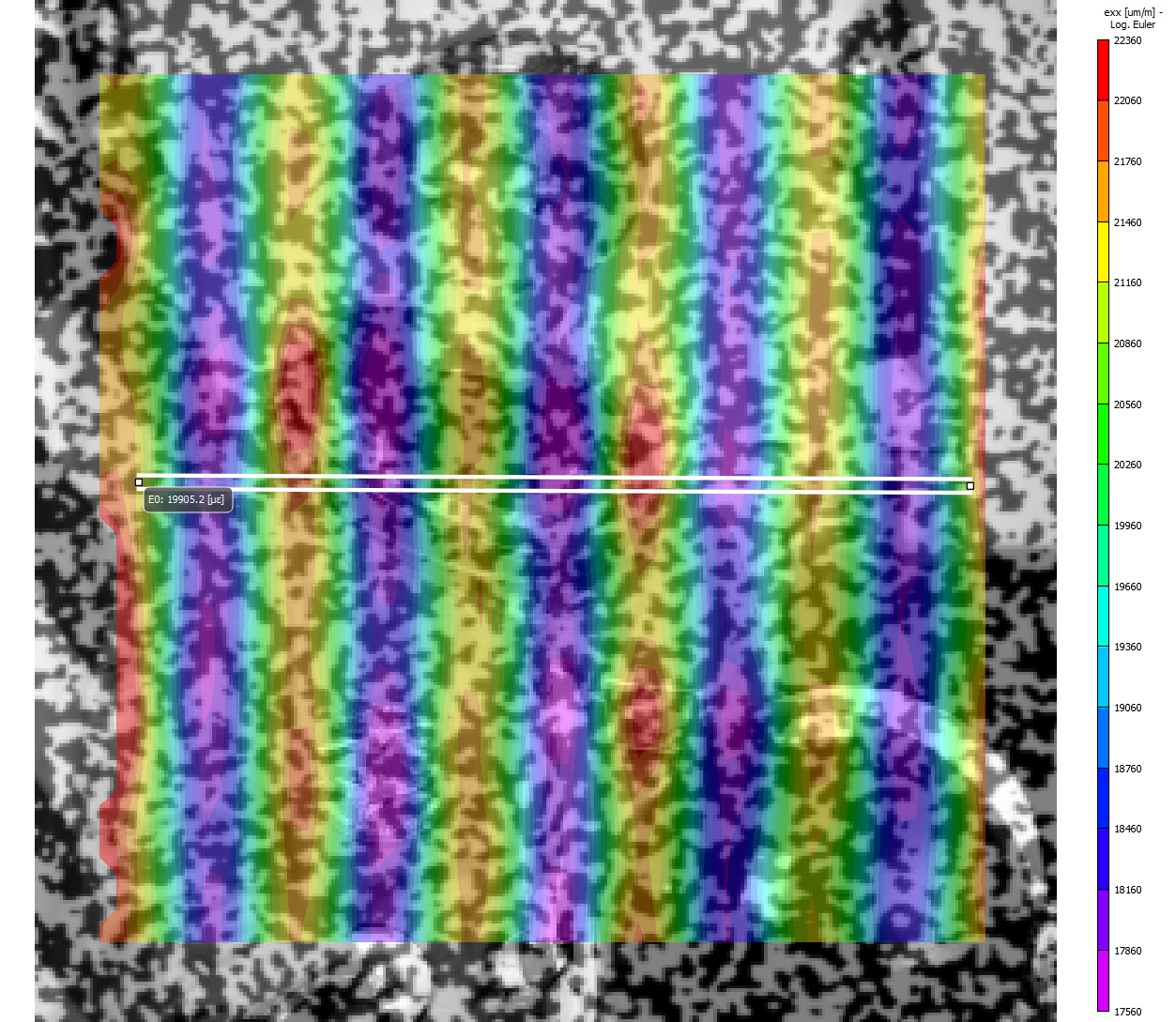
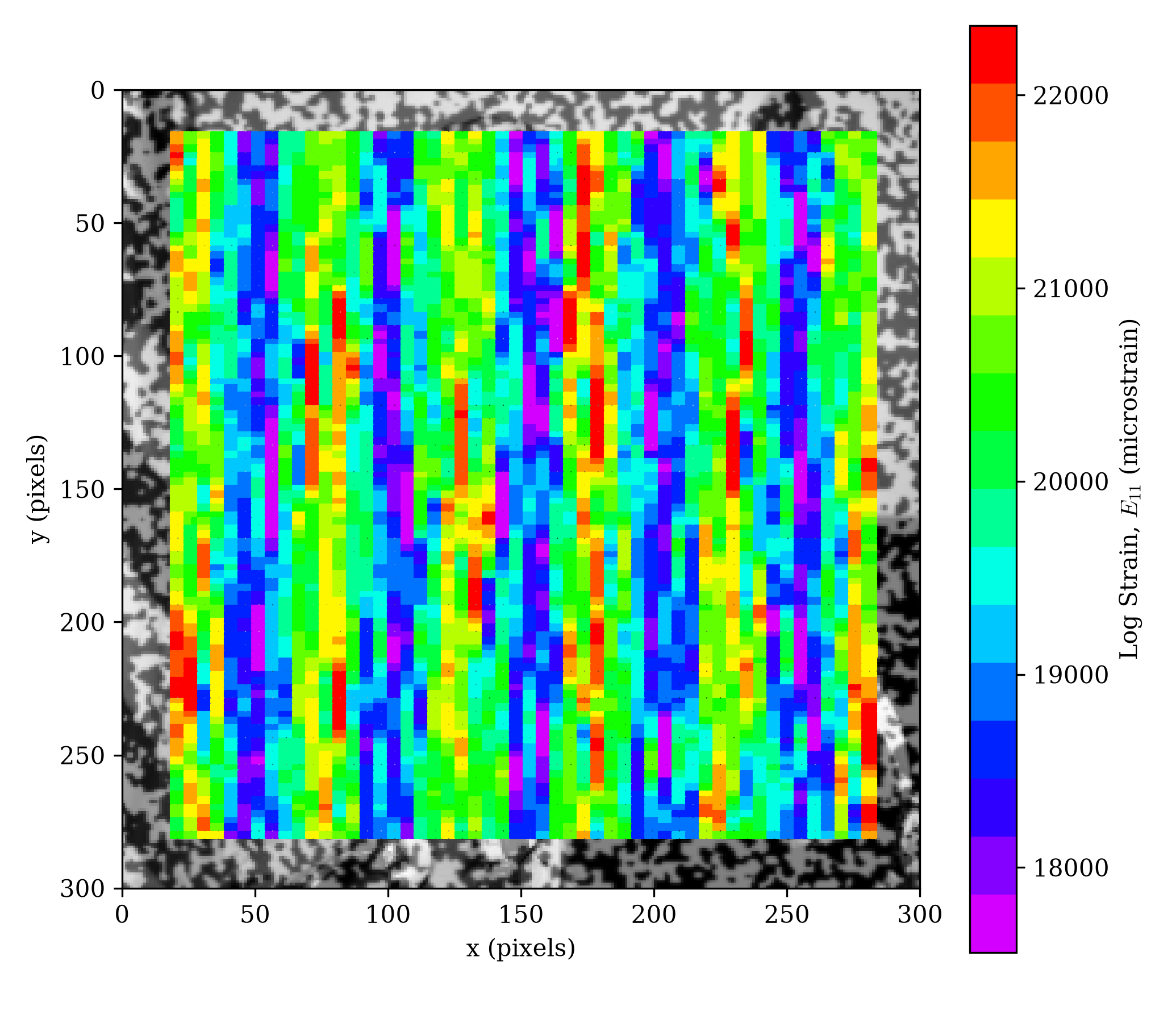
dictk's from locate_warp (right). Both use 17560 to 22360 microstrain and VIC-2D's own 16-band color scale. In High Point Density's version of the right panel, only 9.5% of the Gauss points fell inside this range. The rest clipped to solid magenta or solid red. This one uses the whole scale.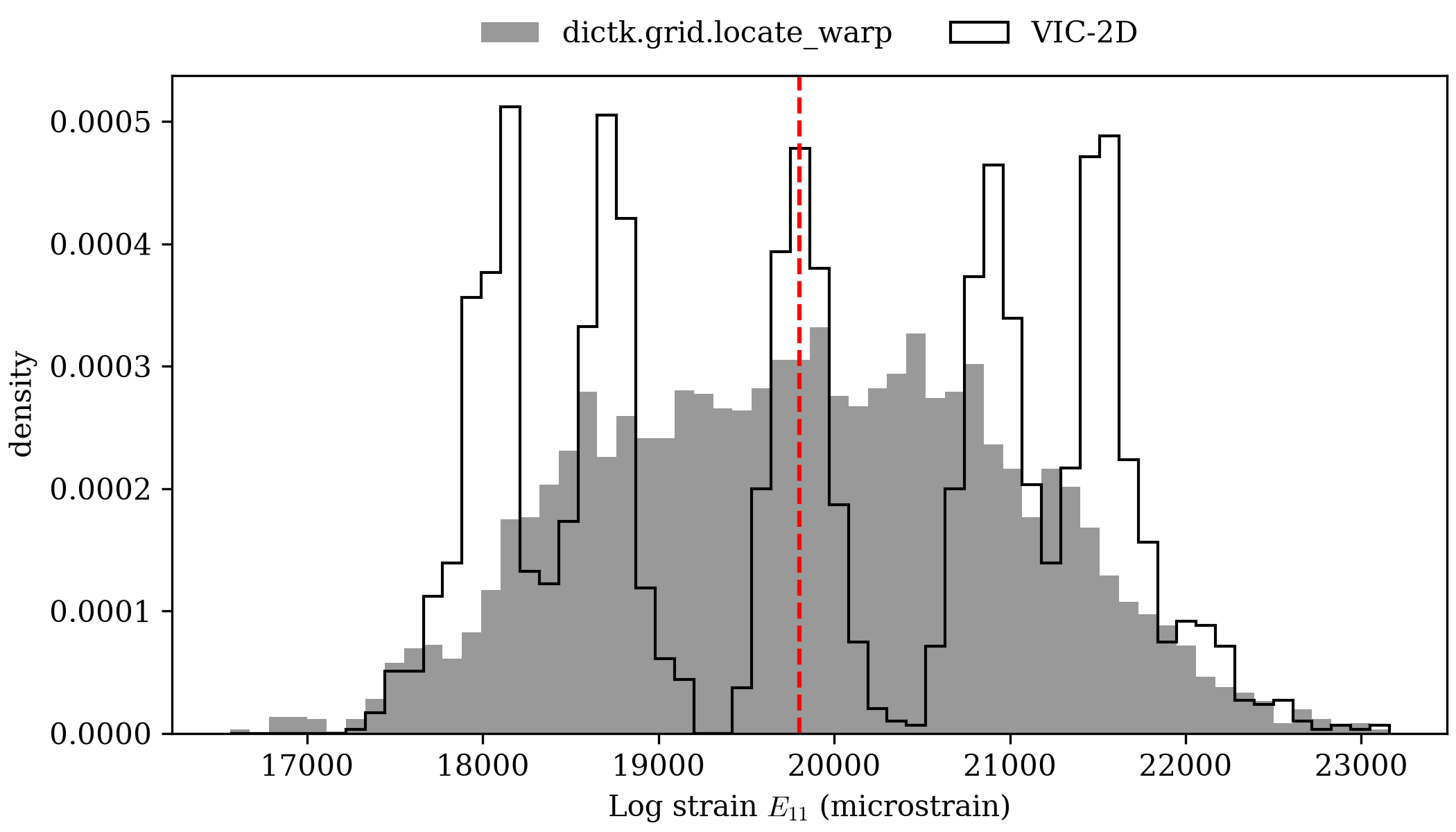
dictk's from locate_warp (gray, 11024 Gauss points) and VIC-2D's (black outline, 2682 points), each normalized to unit area. The dashed red line marks microstrain.The two distributions now cover the same range. Their shapes still
differ. VIC-2D's splits into five clusters. dictk's forms one broad
peak. Both fields keep vertical stripes. Both tools measured the
same bilinear images, and The Residual Wave
below shows those images carry a distortion of their own, tied to each
point's fractional position. Each tracker responds to it differently.
The dictk result is not smoothed. Commercial codes usually also apply a
strain window, fitting displacement over a neighborhood of points
before differentiating. The fit averages the tracking errors of every
point in the window. It also blurs any real strain change inside the
window into one value. Strain Window derives a
strain window and measures it on these tracked positions.
Fixing the bias first matters. A window spanning a whole bias cycle
would also flatten High Point Density's stripes. That averaging would
hide the error while leaving it in the tracked positions.
The Residual Wave
Until now, this page treated the tracker as the source of the error. It
compared locate_subpixel with locate_warp, and locate_warp left a
0.01 px wave. This section isolates the other error contributor, the
generator: the bilinear interpolation image.stretch uses to build
the deformed image. Pixel Locking flagged it earlier.
The measurement here separates the two causes.
dictk.image.stretch builds the current image with bilinear
interpolation. Bilinear interpolation moves content by a fractional
pixel, and it also blurs that content. The blur depends on the
fraction. A whole-pixel position gets none, and a half-pixel position
gets the most. So the stretched image differs from a true
stretch, by an amount that follows each point's fractional position.
Any tracker reads that difference as a position-dependent error. The
table below measures how large.
A quintic spline has no fraction-dependent blur like bilinear interpolation's. It builds a second version of the same 2% stretch. Tracking both versions shows how much of each tracker's error came from the image:
| Current image | Tracker | Std error (px) | Std (µε) |
|---|---|---|---|
bilinear (image.stretch) | locate_subpixel | 0.1091 | 16531 |
bilinear (image.stretch) | locate_warp | 0.0080 | 1161 |
| quintic spline | locate_subpixel | 0.0568 | 10274 |
| quintic spline | locate_warp | 0.0015 | 260 |
With the quintic-spline image, locate_warp's error falls from 0.008 px
to 0.0015 px. Its strain spread falls from 1161 to 260 microstrain. Removing
the generator's distortion cuts IC-GN's error by a factor of 5. locate_subpixel improves
too, from 0.109 px to 0.057 px, but its strain spread stays above 10000
microstrain. About half of phase correlation's error came from the
generator. The other half belongs to the tracker.
Every other figure on this page keeps image.stretch. Every synthetic
image in this book uses bilinear interpolation, not a quintic spline,
and VIC-2D measured those same bilinear images. Setting locate_warp on
the quintic image (260 microstrain) against VIC-2D on a bilinear image
(1385 microstrain) would be an unfair comparison. The two tools would
track different images. So the drop from 1161 to 260 microstrain shows
how much of locate_warp's spread the generator causes. It does not
belong next to VIC-2D's result. The fair comparison stays locate_warp
on the bilinear image, 1161 against VIC-2D's 1385 microstrain.
dictk's own tests of fractional translation avoid the generator
entirely. They shift a smoothed speckle image by an exact fraction of
a pixel, in the Fourier domain. There, locate_warp recovers every
tested shift to within 0.005 px, and beats locate_subpixel every
time.
Summary
The table collects this page's results, one column per approach. Each column has a smaller error standard deviation and a smaller standard deviation than the column before it.
The table leaves out whole-pixel
locate, the baseline. locate rounds every position, so its error
has a standard deviation of 0.30 px on these 2862 points, with the same
kernel and search margins as the other columns. Rounding to the nearest integer alone gives
px.
Subpixel Accuracy compares locate with
locate_subpixel. VIC-2D is the reference tool. locate_subpixel and
locate_warp track the same bilinear image.
The shaded column tracks a different image, a quintic-spline version of
the same 2% stretch. It is not comparable with the other columns.
VIC-2D, locate_subpixel, and locate_warp all tracked the bilinear
images that image.stretch builds. The shaded column shows what
locate_warp would reach if the generator did not distort the image:
0.0015 px and 260 microstrain, down from 0.0080 px and 1161. VIC-2D was
not run on the quintic image, so the table makes no comparison.
locate_subpixel | VIC-2D | locate_warp | locate_warp, quintic image | |
|---|---|---|---|---|
| error Figure | Figure 9.2-1 | Figure 8.1-6 | Figure 9.3-7 | |
| Mean error (px) | -0.0110 | -0.0003 | 0.0000 | +0.0001 |
| Std error (px) | 0.1091 | 0.0154 | 0.0080 | 0.0015 |
| error range (px) | [-0.29, +0.32] | [-0.039, +0.035] | [-0.023, +0.021] | [-0.004, +0.004] |
| Figure | Figure 9.2-5 | Figure 8.1-8 | Figure 9.3-9 | |
| Mean (microstrain) | 20465 | 19876 | 19851 | 19796 |
| Std (microstrain) | 16531 | 1385 | 1161 | 260 |
| range (microstrain) | [-16446, 106134] | [17330, 23137] | [16562, 23160] | [18717, 20618] |
Each error is the tracked minus the true . The
closed-form strain for this 2% stretch is
microstrain. Each mean above
can be compared with that value. The locate_subpixel column uses
upsample_factor=100, which refines the correlation peak to within
0.01 px. High Point Density uses the same value. The VIC-2D column uses
its 2682 valid points for every row. The dictk columns use all 2862
points for and 11024 Gauss points for .
kernel_warping_pixel_locking.py
Show the code
"""Pixel locking: `grid.locate_subpixel`'s own x-error against each
point's known true position, at High Point Density's full 53x54 grid.
Plots the error along one row of the grid, and against the true
position's fractional part.
"""

import matplotlib.pyplot as plt
import numpy as np

from dictk.grid import generate, locate_subpixel
from dictk.image import PixelCoordinate, read, stretch

plt.rcParams.update({"font.family": "serif", "mathtext.fontset": "cm"})

FACTOR_X = 1.02

reference_image = read(path="astronaut0.png")
current_image = stretch(arr=reference_image, factor_x=FACTOR_X)
points = generate(
    origin=PixelCoordinate(x=18, y=16),
    count_x=53,
    count_y=54,
    spacing_x=5,
    spacing_y=5,
)
found = locate_subpixel(
    reference_image=reference_image,
    current_image=current_image,
    reference_points=points,
    kernel_margin_width=13,
    kernel_margin_height=13,
    search_margin_width=25,
    search_margin_height=25,
    upsample_factor=100,
)

true_x = np.array([p.x * FACTOR_X for p in points])
error_x = np.array([f.x for f in found]) - true_x
error_y = np.array([f.y - p.y for f, p in zip(found, points)])
fraction = true_x % 1

print(f"* x error: mean {error_x.mean():+.4f} px, std {error_x.std():.4f} px")
print(f"* y error: mean {error_y.mean():+.4f} px, std {error_y.std():.4f} px")

row = 27
rows = error_x.reshape(54, 53)
row_mean = rows.mean(axis=0)
correlations = [np.corrcoef(r, row_mean)[0, 1] for r in rows]
print()
print(
    f"Each row's x error vs. the all-row mean: correlation "
    f"{min(correlations):.2f} to {max(correlations):.2f}; "
    f"row {row} (y = {points[row * 53].y} px): {correlations[row]:.2f}"
)

bins = np.linspace(0, 1, 11)
centers = (bins[:-1] + bins[1:]) / 2
means = [
    error_x[(fraction >= a) & (fraction < b)].mean() for a, b in zip(bins, bins[1:])
]

fig, (row_axes, fraction_axes) = plt.subplots(
    1, 2, figsize=(10, 4), constrained_layout=True
)
row_x = true_x.reshape(54, 53)[row]
row_axes.plot(row_x, error_x.reshape(54, 53)[row], color="black", marker=".")
row_axes.axhline(0, color="red", linestyle="--", linewidth=1)
for boundary in np.arange(np.ceil(row_x[0]), row_x[-1], 50 * FACTOR_X):
    row_axes.axvline(boundary, color="gray", linestyle=":", linewidth=1)
row_axes.set_xlabel(r"true $x$ (px)")
row_axes.set_ylabel(r"$x$ error (px)")

fraction_axes.scatter(fraction, error_x, s=2, color="gray", alpha=0.4)
fraction_axes.plot(centers, means, color="black", marker="o")
fraction_axes.axhline(0, color="red", linestyle="--", linewidth=1)
fraction_axes.set_xlabel(r"fractional part of true $x$ (px)")
fraction_axes.set_ylabel(r"$x$ error (px)")


fig.savefig("kernel_warping_pixel_locking.png", dpi=300)
print()
print("Saved: kernel_warping_pixel_locking.png")
kernel_warping_panels.py
Show the code
"""Side-by-side illustration of the kernel `locate`/`locate_subpixel`
match (left) against the kernel `locate_warp` warps (right), on one
point under an exaggerated affine deformation.

First sweeps 30 random fractional shifts under that deformation and
reports each function's median error. The figure then uses the shift
whose three errors sit closest to those medians, so the example is
typical, not hand-picked.
"""

import matplotlib.pyplot as plt
import numpy as np
from matplotlib.patches import Polygon
from scipy.ndimage import affine_transform

from dictk import translation, warp
from dictk.image import PixelCoordinate, read

plt.rcParams.update({"font.family": "serif", "mathtext.fontset": "cm"})

# Deformation gradient in (x, y) order: 7% stretch along x plus 0.05
# shear, exaggerated beyond this page's 2% so the warp is visible, with
# distinct values so each one is easy to spot in the printed matrices.
# 15% with 0.15 shear defeats the whole-pixel starting match for about
# a third of shifts; 7% with 0.05 shear defeats none of the 30 below.
F = np.array([[1.07, 0.05], [0.0, 1.0]])
POINT = PixelCoordinate(x=150, y=150)
MARGIN = 13
SEARCH_MARGIN = 25
SHIFT_COUNT = 30
DOT_COUNT = 10
ZOOM = 34

reference_image = read(path="astronaut0.png")
pivot = np.array([POINT.x, POINT.y], dtype=np.float64)
# affine_transform maps each output (row, column) back to its input
# position, so it takes the inverse deformation, in (y, x) order.
inverse = np.linalg.inv(F)[::-1, ::-1]


def deformed(shift):
    offset = pivot[::-1] - inverse @ (pivot[::-1] + shift[::-1])
    return affine_transform(
        reference_image.astype(np.float64), inverse, offset=offset, order=5
    )


def tracked(current_image):
    kwargs = dict(
        reference_image=reference_image,
        current_image=current_image,
        reference_point=POINT,
        search_center=POINT,
        kernel_margin_width=MARGIN,
        kernel_margin_height=MARGIN,
        search_margin_width=SEARCH_MARGIN,
        search_margin_height=SEARCH_MARGIN,
    )
    return (
        translation.locate(**kwargs),
        translation.locate_subpixel(**kwargs),
        warp.locate(**kwargs),
        warp.fit(**kwargs),
    )


names = ["`locate`", "`locate_subpixel`", "`locate_warp`"]
# Rounded to 0.01 px, so each shift prints exactly as used.
shifts = np.round(
    np.random.default_rng(0).uniform([4, 2], [8, 6], size=(SHIFT_COUNT, 2)), 2
)
errors = np.array(
    [
        [
            np.hypot(*(np.array([f.x, f.y]) - pivot - shift))
            for f in tracked(deformed(shift))[:3]
        ]
        for shift in shifts
    ]
)
medians = np.median(errors, axis=0)
print(f"Across {SHIFT_COUNT} random fractional shifts:")
print()
print("| Function | Smallest error (px) | Median error (px) | Largest error (px) |")
print("|---|---|---|---|")
for name, smallest, median, largest in zip(
    names, errors.min(axis=0), medians, errors.max(axis=0)
):
    print(f"| {name} | {smallest:.3f} | {median:.3f} | {largest:.3f} |")

typical = int(np.argmin((np.abs(errors - medians) / medians).sum(axis=1)))
TRANSLATION = shifts[typical]
current_image = deformed(TRANSLATION)
true_position = pivot + TRANSLATION
found_locate, found_subpixel, found_warp, fitted = tracked(current_image)

print()
print(
    f"The most typical shift, ({TRANSLATION[0]:.2f}, {TRANSLATION[1]:.2f}) px, "
    f"puts the true position at ({true_position[0]:.2f}, {true_position[1]:.2f}):"
)
print()
print("| Function | Found $x$ | Found $y$ | Error (px) |")
print("|---|---|---|---|")
for name, found in zip(names, [found_locate, found_subpixel, found_warp]):
    error = np.hypot(found.x - true_position[0], found.y - true_position[1])
    print(f"| {name} | {found.x:.3f} | {found.y:.3f} | {error:.3f} |")

rigid = np.array(
    [
        [1.0, 0.0, found_subpixel.x - POINT.x],
        [0.0, 1.0, found_subpixel.y - POINT.y],
        [0.0, 0.0, 1.0],
    ]
)
true = np.eye(3)
true[:2, :2] = F
true[:2, 2] = TRANSLATION


def latex(matrix, exact):
    """`matrix` as a LaTeX bmatrix. Entries where `exact` is True are
    fixed by construction and print as given (`1`, `0`, `1.15`), not
    padded to four decimals."""
    rows = [
        " & ".join(
            f"{value:g}" if fixed else f"{value:.4f}"
            for value, fixed in zip(row, fixed_row)
        )
        for row, fixed_row in zip(matrix, exact)
    ]
    return "\\begin{bmatrix}" + " \\\\ ".join(rows) + "\\end{bmatrix}"


bottom_row = np.zeros((3, 3), dtype=bool)
bottom_row[2] = True
rigid_exact = bottom_row.copy()
rigid_exact[:2, :2] = True
for name, matrix, exact, note in [
    (r"locate\_subpixel", rigid, rigid_exact, r" \quad (u_x = u_y = v_x = v_y = 0)"),
    (r"locate\_warp", fitted, bottom_row, ""),
    ("true", true, np.ones((3, 3), dtype=bool), ""),
]:
    print()
    print("$$")
    print(f"\\boldsymbol{{W}}_\\text{{{name}}} = {latex(matrix, exact)}{note}")
    print("$$")

offsets = np.linspace(-MARGIN, MARGIN, DOT_COUNT)
grid = np.array([(dx, dy) for dy in offsets for dx in offsets])
square = np.array(
    [[-MARGIN, -MARGIN], [MARGIN, -MARGIN], [MARGIN, MARGIN], [-MARGIN, MARGIN]]
)

fig, (left, right) = plt.subplots(1, 2, figsize=(10, 5.2), constrained_layout=True)
for ax in (left, right):
    ax.imshow(current_image, cmap="gray", vmin=0, vmax=255)
    ax.set_xlim(pivot[0] - ZOOM, pivot[0] + ZOOM)
    ax.set_ylim(pivot[1] + ZOOM, pivot[1] - ZOOM)
    ax.set_xlabel("x (pixels)")
    ax.set_ylabel("y (pixels)")
    ax.add_patch(
        Polygon(
            pivot + square,
            fill=False,
            edgecolor="white",
            linestyle="--",
            linewidth=1.5,
        )
    )
    ax.plot(*true_position, marker="+", color="red", markersize=14, mew=2)

for ax, found, corners, dots, title in [
    (
        left,
        found_subpixel,
        square,
        grid,
        "locate, locate_subpixel: rigid square kernel",
    ),
    (
        right,
        found_warp,
        square @ fitted[:2, :2].T,
        grid @ fitted[:2, :2].T,
        "locate_warp: affine-warped kernel",
    ),
]:
    center = np.array([found.x, found.y])
    ax.annotate(
        "",
        xy=center,
        xytext=pivot,
        arrowprops=dict(arrowstyle="-|>", color="orange", linewidth=2),
    )
    ax.add_patch(Polygon(center + corners, fill=False, edgecolor="orange", linewidth=2))
    ax.scatter(*(center + dots).T, s=8, color="orange")
    ax.set_title(title)

fig.savefig("kernel_warping_panels.png", dpi=300)
kernel_warping_steepest.py
Show the code
"""The six steepest-descent images of IC-GN's update, for the reference
kernel at the point Kernel Warping's panel figure tracks. Each image is
one component of s(xi), in the same order as p = (u, u_x, u_y, v, v_x,
v_y). The Hessian H is built from these six images alone.
"""

import matplotlib.pyplot as plt
import numpy as np

from dictk.image import read

plt.rcParams.update({"font.family": "serif", "mathtext.fontset": "cm"})

X0, Y0 = 150, 150
MARGIN = 13

reference_image = read(path="astronaut0.png").astype(np.float64)
gradient_y, gradient_x = np.gradient(reference_image)
rows = slice(Y0 - MARGIN, Y0 + MARGIN + 1)
columns = slice(X0 - MARGIN, X0 + MARGIN + 1)
fx = gradient_x[rows, columns]
fy = gradient_y[rows, columns]
dy, dx = np.mgrid[-MARGIN : MARGIN + 1, -MARGIN : MARGIN + 1].astype(np.float64)

components = [
    (r"$u$:  $f_x$", fx),
    (r"$u_x$:  $f_x\,\Delta x$", fx * dx),
    (r"$u_y$:  $f_x\,\Delta y$", fx * dy),
    (r"$v$:  $f_y$", fy),
    (r"$v_x$:  $f_y\,\Delta x$", fy * dx),
    (r"$v_y$:  $f_y\,\Delta y$", fy * dy),
]
extent = (-MARGIN - 0.5, MARGIN + 0.5, MARGIN + 0.5, -MARGIN - 0.5)
fig, axes = plt.subplots(2, 3, figsize=(10, 6.4), constrained_layout=True)
for ax, (title, values) in zip(axes.flat, components):
    limit = np.abs(values).max()
    shown = ax.imshow(values, cmap="RdBu_r", vmin=-limit, vmax=limit, extent=extent)
    ax.set_title(title)
    ax.set_xlabel(r"$\Delta x$ (px)")
    ax.set_ylabel(r"$\Delta y$ (px)")
    fig.colorbar(shown, ax=ax, shrink=0.8)
fig.savefig("kernel_warping_steepest.png", dpi=200)
kernel_warping_iterations.py
Show the code
"""IC-GN iteration by iteration, on Kernel Warping's panel-figure example:
the point at (150, 150) under a 7% stretch, 0.05 shear, and the typical
shift (6.43, 4.92) that kernel_warping_panels.py selects. warp.fit with
max_iterations=k returns the warp after k iterations. Iteration 0 is the
whole-pixel start from translation.locate.
"""

import matplotlib.pyplot as plt
import numpy as np
from scipy.ndimage import affine_transform, map_coordinates

from dictk import translation, warp
from dictk.image import PixelCoordinate, read

plt.rcParams.update({"font.family": "serif", "mathtext.fontset": "cm"})

F = np.array([[1.07, 0.05], [0.0, 1.0]])
SHIFT = np.array([6.43, 4.92])
POINT = PixelCoordinate(x=150, y=150)
MARGIN = 13
SEARCH_MARGIN = 25
RESIDUAL_ITERATIONS = [0, 1, 2, 3]

reference_image = read(path="astronaut0.png").astype(np.float64)
pivot = np.array([POINT.x, POINT.y], dtype=np.float64)
inverse = np.linalg.inv(F)[::-1, ::-1]
offset = pivot[::-1] - inverse @ (pivot[::-1] + SHIFT[::-1])
current_image = affine_transform(reference_image, inverse, offset=offset, order=5)
kwargs = dict(
    reference_image=reference_image,
    current_image=current_image,
    reference_point=POINT,
    search_center=POINT,
    kernel_margin_width=MARGIN,
    kernel_margin_height=MARGIN,
    search_margin_width=SEARCH_MARGIN,
    search_margin_height=SEARCH_MARGIN,
)

dy, dx = np.mgrid[-MARGIN : MARGIN + 1, -MARGIN : MARGIN + 1].astype(np.float64)
f = reference_image[
    POINT.y - MARGIN : POINT.y + MARGIN + 1, POINT.x - MARGIN : POINT.x + MARGIN + 1
]
f_tilde = f - f.mean()


def warp_at(iterations):
    if iterations == 0:
        start = translation.locate(**kwargs)
        return np.array(
            [[1.0, 0.0, start.x - POINT.x], [0.0, 1.0, start.y - POINT.y], [0, 0, 1.0]]
        )
    return warp.fit(**kwargs, max_iterations=iterations)


def residual(matrix):
    xs = POINT.x + matrix[0, 0] * dx + matrix[0, 1] * dy + matrix[0, 2]
    ys = POINT.y + matrix[1, 0] * dx + matrix[1, 1] * dy + matrix[1, 2]
    g = map_coordinates(current_image, [ys, xs], order=3)
    g_tilde = g - g.mean()
    znssd = np.sum(
        (f_tilde / np.linalg.norm(f_tilde) - g_tilde / np.linalg.norm(g_tilde)) ** 2
    )
    scale = np.linalg.norm(f_tilde) / np.linalg.norm(g_tilde)
    return scale * g_tilde - f_tilde, znssd


final = warp.fit(**kwargs)
iterations = [0]
while not np.allclose(warp_at(iterations[-1]), final, rtol=0, atol=1e-12):
    iterations.append(iterations[-1] + 1)
records = []
for k in iterations:
    matrix = warp_at(k)
    r, znssd = residual(matrix)
    translation_error = np.hypot(*(matrix[:2, 2] - SHIFT))
    gradient_error = np.abs(matrix[:2, :2] - F).max()
    records.append((k, znssd, translation_error, gradient_error, r))

print(f"IC-GN reaches its final warp after {iterations[-1]} iterations:")
print()
print("| Iteration $k$ | ZNSSD $C$ | Translation error (px) | Gradient error |")
print("|---|---|---|---|")
for k, znssd, translation_error, gradient_error, _ in records:
    print(f"| {k} | {znssd:.2e} | {translation_error:.2e} | {gradient_error:.2e} |")

shown = [record for record in records if record[0] in RESIDUAL_ITERATIONS]
limit = np.abs(shown[0][4]).max()
fig, axes = plt.subplots(
    1, len(shown), figsize=(10, 3.1), constrained_layout=True, squeeze=False
)
extent = (-MARGIN - 0.5, MARGIN + 0.5, MARGIN + 0.5, -MARGIN - 0.5)
for ax, (k, znssd, _, _, r) in zip(axes.flat, shown):
    image = ax.imshow(r, cmap="RdBu_r", vmin=-limit, vmax=limit, extent=extent)
    ax.set_title(f"$k = {k}$,  $C = {znssd:.2g}$")
    ax.set_xlabel(r"$\Delta x$ (px)")
axes.flat[0].set_ylabel(r"$\Delta y$ (px)")
fig.colorbar(image, ax=axes.flat[-1], shrink=0.85, label="residual $r$")
fig.savefig("kernel_warping_residuals.png", dpi=200)

ks = [record[0] for record in records]
fig, (left, right) = plt.subplots(1, 2, figsize=(10, 3.6), constrained_layout=True)
left.semilogy(ks, [record[2] for record in records], "o-", color="black")
left.set_title("translation error")
left.set_ylabel("error (px)")
right.semilogy(ks, [record[3] for record in records], "o-", color="black")
right.set_title("gradient error")
right.set_ylabel(r"largest $|W_{ij} - F_{ij}|$")
for ax in (left, right):
    ax.set_xlabel("iteration $k$")
    ax.set_xticks(ks)
    ax.grid(True, which="major", color="0.85", linewidth=0.8)
fig.savefig("kernel_warping_convergence.png", dpi=200)
kernel_warping_bias.py
Show the code
"""The same fractional-position error curve as
kernel_warping_pixel_locking.py, for both `grid.locate_subpixel` and
`grid.locate_warp`, on the same axes.
"""

import time

import matplotlib.pyplot as plt
import numpy as np

from dictk.grid import generate, locate_subpixel, locate_warp
from dictk.image import PixelCoordinate, read, stretch

plt.rcParams.update({"font.family": "serif", "mathtext.fontset": "cm"})

FACTOR_X = 1.02

reference_image = read(path="astronaut0.png")
current_image = stretch(arr=reference_image, factor_x=FACTOR_X)
points = generate(
    origin=PixelCoordinate(x=18, y=16),
    count_x=53,
    count_y=54,
    spacing_x=5,
    spacing_y=5,
)
kwargs = dict(
    reference_image=reference_image,
    current_image=current_image,
    reference_points=points,
    kernel_margin_width=13,
    kernel_margin_height=13,
    search_margin_width=25,
    search_margin_height=25,
)

true_x = np.array([p.x * FACTOR_X for p in points])
fraction = true_x % 1
bins = np.linspace(0, 1, 11)
centers = (bins[:-1] + bins[1:]) / 2

fig, ax = plt.subplots(figsize=(7, 4), constrained_layout=True)
print(
    "| Tracker | Time (s) | Mean $x$ error (px) | Std $x$ error (px) | Max \\|$x$ error\\| (px) |"
)
print("|---|---|---|---|---|")
for name, locate, extra, marker in [
    ("`locate_subpixel`", locate_subpixel, dict(upsample_factor=100), "o"),
    ("`locate_warp`", locate_warp, {}, "s"),
]:
    start = time.perf_counter()
    found = locate(**kwargs, **extra)
    elapsed = time.perf_counter() - start
    error_x = np.array([f.x for f in found]) - true_x
    print(
        f"| {name} | {elapsed:.1f} | {error_x.mean():+.4f} | {error_x.std():.4f} "
        f"| {np.abs(error_x).max():.4f} |"
    )
    means = [
        error_x[(fraction >= a) & (fraction < b)].mean() for a, b in zip(bins, bins[1:])
    ]
    ax.plot(centers, means, color="black", marker=marker, label=name.strip("`"))
ax.axhline(0, color="red", linestyle="--", linewidth=1)
ax.set_xlabel(r"fractional part of true $x$ (px)")
ax.set_ylabel(r"mean $x$ error (px)")
ax.legend(frameon=False)
fig.savefig("kernel_warping_bias.png", dpi=300)
kernel_warping_strain.py
Show the code
"""High Point Density's own strain pipeline, rerun on `grid.locate_warp`
positions: a summary table against `grid.locate_subpixel` and VIC-2D,
the field on VIC-2D's own colorbar, and the distribution against
VIC-2D's own.
"""

import csv

import matplotlib.pyplot as plt
import numpy as np
from matplotlib.colors import ListedColormap

from dictk.element import gauss_point_coordinates, gauss_point_log_strains
from dictk.grid import elements, generate, locate_subpixel, locate_warp
from dictk.image import PixelCoordinate, read, stretch
from dictk.plot import element_strain_plot

plt.rcParams.update({"font.family": "serif", "mathtext.fontset": "cm"})

FACTOR_X = 1.02
VMIN, VMAX = 17560, 22360

reference_image = read(path="astronaut0.png")
current_image = stretch(arr=reference_image, factor_x=FACTOR_X)
points = generate(
    origin=PixelCoordinate(x=18, y=16),
    count_x=53,
    count_y=54,
    spacing_x=5,
    spacing_y=5,
)
kwargs = dict(
    reference_image=reference_image,
    current_image=current_image,
    reference_points=points,
    kernel_margin_width=13,
    kernel_margin_height=13,
    search_margin_width=25,
    search_margin_height=25,
)
element_indices = elements(count_x=53, count_y=54)


def strains(found):
    values, coordinates = [], []
    for element in element_indices:
        current_corners = [found[i] for i in element]
        values.extend(
            strain[0, 0]
            for strain in gauss_point_log_strains(
                reference_points=[points[i] for i in element],
                current_points=current_corners,
            )
        )
        coordinates.extend(gauss_point_coordinates(points=current_corners))
    return np.array(values) * 1e6, coordinates


phase, _ = strains(locate_subpixel(**kwargs, upsample_factor=100))
found = locate_warp(**kwargs)
warp, coordinates = strains(found)

with open("../verification/simple_stretch_vic_out.csv") as f:
    rows = [{k.strip(' "'): v for k, v in row.items()} for row in csv.DictReader(f)]
vic = np.array([float(r["exx"]) * 1e6 for r in rows if float(r["sigma"]) != -1])
analytical = np.log(FACTOR_X) * 1e6

print(
    f"| Source | Mean (µε) | Std (µε) | Min (µε) | Max (µε) | Inside [{VMIN}, {VMAX}] |"
)
print("|---|---:|---:|---:|---:|---:|")
for name, values in [
    ("`locate_subpixel` + Q4", phase),
    ("VIC-2D", vic),
    ("`locate_warp` + Q4", warp),
]:
    inside = np.mean((values >= VMIN) & (values <= VMAX)) * 100
    print(
        f"| {name} | {values.mean():.0f} | {values.std():.0f} | {values.min():.0f} "
        f"| {values.max():.0f} | {inside:.1f}% |"
    )
print(f"| Analytical, $\\ln(1.02)$ | {analytical:.0f} | 0 | | | |")

vic2d_cmap = ListedColormap(
    [
        (0.8314, 0.0000, 1.0000),
        (0.5176, 0.0000, 1.0000),
        (0.1843, 0.0000, 1.0000),
        (0.0000, 0.1333, 1.0000),
        (0.0000, 0.4510, 1.0000),
        (0.0000, 0.7843, 1.0000),
        (0.0000, 1.0000, 0.8980),
        (0.0000, 1.0000, 0.5843),
        (0.0000, 1.0000, 0.2510),
        (0.0667, 1.0000, 0.0000),
        (0.3843, 1.0000, 0.0000),
        (0.7176, 1.0000, 0.0000),
        (1.0000, 0.9686, 0.0000),
        (1.0000, 0.6510, 0.0000),
        (1.0000, 0.3176, 0.0000),
        (1.0000, 0.0000, 0.0000),
    ]
)
element_strain_plot(
    points=found,
    elements=element_indices,
    coordinates=coordinates,
    values=warp,
    label=r"Log Strain, $E_{11}$ (microstrain)",
    image=current_image,
    dot_size=6,
    marker="s",
    show_mesh_lines=False,
    cmap=vic2d_cmap,
    vmin=VMIN,
    vmax=VMAX,
    figsize=(6.9, 6.0),
    path="kernel_warping_strain_vic_colorbar.png",
)

fig, ax = plt.subplots(figsize=(7, 4), constrained_layout=True)
bins = np.linspace(min(warp.min(), vic.min()), max(warp.max(), vic.max()), 61)
ax.hist(
    warp,
    bins=bins,
    density=True,
    color="gray",
    alpha=0.8,
    label="dictk.grid.locate_warp",
)
ax.hist(vic, bins=bins, density=True, histtype="step", color="black", label="VIC-2D")
ax.axvline(analytical, color="red", linestyle="--", linewidth=1.5)
ax.set_xlabel(r"Log strain $E_{11}$ (microstrain)")
ax.set_ylabel("density")
ax.legend(loc="lower center", bbox_to_anchor=(0.5, 1.0), ncol=2, frameon=False)
fig.savefig("kernel_warping_strain_histogram.png", dpi=300)
kernel_warping_generator.py
Show the code
"""The same 2% stretch, generated two ways: `dictk.image.stretch`'s own
bilinear interpolation, and a quintic spline. Tracks both with
`grid.locate_subpixel` and `grid.locate_warp`, then reports each
combination's x error and E11 spread.
"""

import numpy as np
from scipy.ndimage import map_coordinates

from dictk.element import gauss_point_log_strains
from dictk.grid import elements, generate, locate_subpixel, locate_warp
from dictk.image import PixelCoordinate, read, stretch

FACTOR_X = 1.02

reference_image = read(path="astronaut0.png")
height, width = reference_image.shape
ys, xs = np.mgrid[0:height, 0:width].astype(np.float64)
generators = {
    "bilinear (`image.stretch`)": stretch(arr=reference_image, factor_x=FACTOR_X),
    "quintic spline": map_coordinates(
        reference_image.astype(np.float64), [ys, xs / FACTOR_X], order=5
    ),
}
points = generate(
    origin=PixelCoordinate(x=18, y=16),
    count_x=53,
    count_y=54,
    spacing_x=5,
    spacing_y=5,
)
element_indices = elements(count_x=53, count_y=54)
true_x = np.array([p.x * FACTOR_X for p in points])

print("| Current image | Tracker | Std $x$ error (px) | Std $E_{11}$ (µε) |")
print("|---|---|---|---|")
for generator, current_image in generators.items():
    for name, locate, extra in [
        ("`locate_subpixel`", locate_subpixel, dict(upsample_factor=100)),
        ("`locate_warp`", locate_warp, {}),
    ]:
        found = locate(
            reference_image=reference_image,
            current_image=current_image,
            reference_points=points,
            kernel_margin_width=13,
            kernel_margin_height=13,
            search_margin_width=25,
            search_margin_height=25,
            **extra,
        )
        error_x = np.array([f.x for f in found]) - true_x
        strains = np.array(
            [
                strain[0, 0]
                for element in element_indices
                for strain in gauss_point_log_strains(
                    reference_points=[points[i] for i in element],
                    current_points=[found[i] for i in element],
                )
            ]
        )
        print(
            f"| {generator} | {name} | {error_x.std():.4f} "
            f"| {strains.std() * 1e6:.0f} |"
        )
kernel_warping_x_error_histogram.py
Show the code
"""Distribution of `grid.locate_warp`'s x error across the full 53x54
grid on `image.stretch`'s bilinear image: the tracked x minus the true
x = 1.02 X, with the mean and one standard deviation marked.
"""

import matplotlib.pyplot as plt
import numpy as np

from dictk.grid import generate, locate_warp
from dictk.image import PixelCoordinate, read, stretch

FACTOR_X = 1.02

reference_image = read(path="astronaut0.png")
current_image = stretch(arr=reference_image, factor_x=FACTOR_X)
points = generate(
    origin=PixelCoordinate(x=18, y=16),
    count_x=53,
    count_y=54,
    spacing_x=5,
    spacing_y=5,
)
found = locate_warp(
    reference_image=reference_image,
    current_image=current_image,
    reference_points=points,
    kernel_margin_width=13,
    kernel_margin_height=13,
    search_margin_width=25,
    search_margin_height=25,
)

error_x = np.array([f.x for f in found]) - np.array([p.x * FACTOR_X for p in points])
mean = error_x.mean()
std = error_x.std()
print(
    f"{len(points)} points: mean x error {mean:+.5f} px, std {std:.4f} px, "
    f"range [{error_x.min():+.3f}, {error_x.max():+.3f}] px"
)

plt.rcParams.update({"font.family": "serif", "mathtext.fontset": "cm"})
fig, ax = plt.subplots(figsize=(7, 4), constrained_layout=True)
ax.hist(error_x, bins=60, color="gray", alpha=0.8, label=r"$x$ error at 2862 points")
ax.axvspan(
    mean - std,
    mean + std,
    color="royalblue",
    alpha=0.15,
    label=rf"$\pm$ 1 standard deviation, {std:.4f} px",
)
mean_text = f"{mean:+.4f}" if round(mean, 4) else "0.0000"
ax.axvline(mean, color="black", linewidth=1.5, label=f"mean, {mean_text} px")
ax.axvline(0, color="red", linestyle="--", linewidth=1.5, label="exact tracking, 0 px")
ax.set_xlabel(r"$x$ error (px)")
ax.set_ylabel("frequency")
ax.set_ylim(top=ax.get_ylim()[1] * 1.45)
legend = ax.legend(loc="upper right", framealpha=1.0)
legend.set_zorder(10)
fig.savefig("kernel_warping_x_error_histogram.png", dpi=300)
kernel_warping_summary.py
Show the code
"""Summary of Kernel Warping's progression as one HTML table:
`locate_subpixel`, VIC-2D, and `locate_warp` on `image.stretch`'s
bilinear image, then `locate_warp` on a quintic-spline image. Reports the
mean and standard deviation of each tracker's x error and of its E11.
"""

import csv

import numpy as np
from scipy.ndimage import map_coordinates

from dictk.element import gauss_point_log_strains
from dictk.grid import elements, generate, locate_subpixel, locate_warp
from dictk.image import PixelCoordinate, read, stretch

FACTOR_X = 1.02

reference_image = read(path="astronaut0.png")
height, width = reference_image.shape
ys, xs = np.mgrid[0:height, 0:width].astype(np.float64)
bilinear_image = stretch(arr=reference_image, factor_x=FACTOR_X)
quintic_image = map_coordinates(
    reference_image.astype(np.float64), [ys, xs / FACTOR_X], order=5
)
points = generate(
    origin=PixelCoordinate(x=18, y=16),
    count_x=53,
    count_y=54,
    spacing_x=5,
    spacing_y=5,
)
element_indices = elements(count_x=53, count_y=54)
true_x = np.array([p.x * FACTOR_X for p in points])


def track(tracker, image, **extra):
    return tracker(
        reference_image=reference_image,
        current_image=image,
        reference_points=points,
        kernel_margin_width=13,
        kernel_margin_height=13,
        search_margin_width=25,
        search_margin_height=25,
        **extra,
    )


def statistics(found):
    error_x = np.array([f.x for f in found]) - true_x
    strains = (
        np.array(
            [
                strain[0, 0]
                for element in element_indices
                for strain in gauss_point_log_strains(
                    reference_points=[points[i] for i in element],
                    current_points=[found[i] for i in element],
                )
            ]
        )
        * 1e6
    )
    return (
        error_x.mean(),
        error_x.std(),
        (error_x.min(), error_x.max()),
        strains.mean(),
        strains.std(),
        (strains.min(), strains.max()),
    )


with open("../verification/simple_stretch_vic_out.csv") as f:
    rows = [{k.strip(' "'): v for k, v in row.items()} for row in csv.DictReader(f)]
valid = [r for r in rows if float(r["sigma"]) != -1]
vic_error_x = np.array(
    [float(r["x"]) + float(r["u"]) - FACTOR_X * float(r["x"]) for r in valid]
)
vic_strain = np.array([float(r["exx"]) * 1e6 for r in valid])

columns = [
    (
        "<code>locate_subpixel</code>",
        statistics(track(locate_subpixel, bilinear_image, upsample_factor=100)),
        "",
    ),
    (
        "VIC-2D",
        (
            vic_error_x.mean(),
            vic_error_x.std(),
            (vic_error_x.min(), vic_error_x.max()),
            vic_strain.mean(),
            vic_strain.std(),
            (vic_strain.min(), vic_strain.max()),
        ),
        "",
    ),
    ("<code>locate_warp</code>", statistics(track(locate_warp, bilinear_image)), ""),
    (
        "<code>locate_warp</code>, quintic image",
        statistics(track(locate_warp, quintic_image)),
        ' class="unreachable"',
    ),
]


def range_format(bounds):
    decimals = 2 if max(abs(b) for b in bounds) >= 0.1 else 3
    low, high = bounds
    return f"[{low:+.{decimals}f}, {high:+.{decimals}f}]"


labels = [
    ("Mean $x$ error (px)", lambda v: f"{v:+.4f}" if round(v, 4) else "0.0000"),
    ("Std $x$ error (px)", lambda v: f"{v:.4f}"),
    ("$x$ error range (px)", range_format),
    ("Mean $E_{11}$ (microstrain)", lambda v: f"{v:.0f}"),
    ("Std $E_{11}$ (microstrain)", lambda v: f"{v:.0f}"),
    ("$E_{11}$ range (microstrain)", lambda v: f"[{round(v[0])}, {round(v[1])}]"),
]
figure_rows = {
    0: (
        "$x$ error Figure",
        {
            "VIC-2D": "./simple_stretch.html#fig-vic-x-error-histogram",
            "<code>locate_subpixel</code>": "./high_point_density.html#fig-hpd-x-error-histogram",
            "<code>locate_warp</code>": "#fig-kw-x-error-histogram",
        },
    ),
    3: (
        "$E_{11}$ Figure",
        {
            "VIC-2D": "./simple_stretch.html#fig-vic-exx-histogram",
            "<code>locate_subpixel</code>": "./high_point_density.html#fig-hpd-strain-histogram",
            "<code>locate_warp</code>": "#fig-kw-strain-histogram",
        },
    ),
}

print('<table class="progression">')
print("<thead><tr><th></th>", end="")
for name, _, css in columns:
    print(f"<th{css}>{name}</th>", end="")
print("</tr></thead>")
print("<tbody>")
for row, (label, fmt) in enumerate(labels):
    if row in figure_rows:
        figure_label, targets = figure_rows[row]
        print(f"<tr><td>{figure_label}</td>", end="")
        for name, _, css in columns:
            link = f'<a href="{targets[name]}">Figure</a>' if name in targets else ""
            print(f"<td{css}>{link}</td>", end="")
        print("</tr>")
    print(f"<tr><td>{label}</td>", end="")
    for _, values, css in columns:
        print(f"<td{css}>{fmt(values[row])}</td>", end="")
    print("</tr>")
print("</tbody>")
print("</table>")